
 0
0
 456 views
Date: May 15–October 30, 2031
Location: Global digital networks, local governance halls, and the quiet spaces where people decide what they’re willing to pay for with their hope
Weather: Not a season, but a feeling—the crisp clarity of choice after long uncertainty.
It began with a question posted on the open breath-forum by a fisherman in Kerala:
“If the UCCA belongs to cities and people, not nations… who pays for its breath?”
The question floated for days, collecting resonance.
Then a teacher in Nairobi replied:
“We do. Or it will never be ours.”
And so the most radical economic experiment in human history began—
not with a summit, but with a suggestion.
Not with a treaty, but with a choice.
________________________________________
The Proposal
The United Coalition of City Assemblies had been running on emergency grants, goodwill, and digital infrastructure borrowed from sympathetic city networks.
But as its influence grew—mediating water disputes, coordinating climate migration, managing the Quiet Zone accords—the old funding models strained.
Nations offered support, but with conditions.
“Observers” on budgeting committees.
“Advisory roles” in conflict resolution.
The subtle, persistent pressure of the purse.
Amara Okonkwo knew what was coming.
She’d seen it before at the UN—the way money became leverage, the way leverage became control.
So when the forum thread reached critical resonance, she convened an emergency digital session of the UCCA.
Not to propose a solution.
To amplify one that was already emerging.
________________________________________
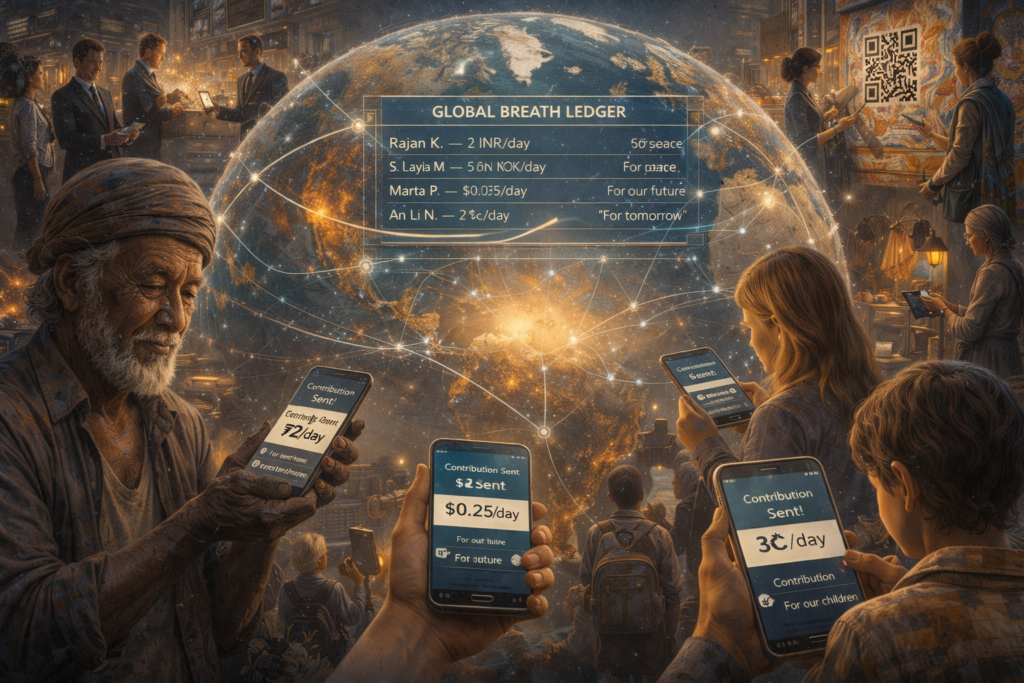
The Platform: The Global Breath Ledger
Priya and her team had been working on it for months in secret—
a blockchain-inspired, transparent accounting system built on the same infrastructure as the resonance network.
They called it The Breath Ledger.
Every transaction would be:
• Public
• Traceable
• Non-reversible
• Fee-free
• Convertible across all local currencies
But the real innovation was the giving mechanism.
Instead of taxes, it used micro-contributions—
voluntary, recurring donations as small as one-hundredth of a local currency unit per day.
A Breath-Penny.
The ask was simple:
“Give what a daily breath is worth to you.”
________________________________________
The Covenant
The official proposal, drafted collectively in seven languages, was called:
The People’s Funding Covenant for the United Coalition of City Assemblies
Key clauses:
1. Voluntary Participation: No mandatory contributions, ever.
2. Complete Transparency: Every expense publicly listed in real time.
3. City-Level Allocation: 70% of funds directed to city-submitted proposals, 30% to global coordination.
4. No Nation-State Interference: Nations could contribute, but with zero voting power or oversight.
5. The Sunset Clause: If global resonance fell below 40% for 90 consecutive days, the UCCA would dissolve and return remaining funds.
It was governance as a public trust—
literally.
________________________________________
The First Contributor
The fisherman from Kerala, Rajan, was the first to enroll.
He recorded a short breath-video on his ancient, patched-together tablet:
“I have fished these waters for forty years. I have seen treaties signed and broken. I have seen aid come with strings. This… this feels like paying for my own future. Not someone else’s idea of it.”
He set his contribution:
2 Indian rupees per day.
About three cents USD.
The ledger registered:
*Contribution #001 — Rajan K. — Kerala Coastal Collective — 2 INR/day — “For breath without borders”*
Within an hour, a thousand more had joined.
________________________________________
The Global Response
It wasn’t uniform.
It was beautifully, chaotically human.
In Norway, citizens voted to redirect 1% of their national carbon tax to the UCCA—a municipal-level override that triggered a constitutional crisis the government quietly lost.
In Detroit, a coalition of retired autoworkers set up a community kiosk where people could round up their grocery purchases to the nearest dollar, with the change going to the ledger.
In São Paulo, street artists painted QR codes on murals that linked directly to contribution portals.
The caption: “Your art funds our heart.”
In rural Mongolia, herders donated livestock credits—
virtual shares of sheep and goats that could be sold on sustainable markets, with proceeds flowing to the ledger.
In Dubai, the AI-governed wealth funds allocated 0.5% of their returns automatically—
the first non-human entities to contribute.
________________________________________
The Backlash
Nations with controlling governments reacted predictably.
China issued a statement: “Unauthorized fiscal collections violate national sovereignty.”
They firewalled the ledger within their borders.
Russia called it “digital colonialism.”
Several governments warned of “governance without accountability.”
The United States Congress drafted (but never passed) the “Transnational Funding Transparency Act”—a thinly veiled attempt to regulate the ledger into irrelevance.
But they couldn’t stop it.
Because the ledger wasn’t hosted in a country.
It was hosted in the network itself—
distributed across millions of devices, breathing in the spaces between firewalls.
________________________________________
The Emotional Economics
What surprised economists wasn’t the volume of contributions—
it was the consistency.
People gave:
• When they felt hopeful
• When they felt angry at their own governments
• When they saw a UCCA mediation prevent a water war
• When a Quiet Zone was officially recognized
• When the Children’s Promise was published
They didn’t give because they had to.
They gave because it felt like building something they could believe in.
A behavioral economist from Cambridge called it “the first truly post-national fiscal identity.”
A grandmother in Ghana called it “paying for my grandchildren’s air.”
Both were right.
________________________________________
The Threshold
The Covenant needed one billion daily contributors to be viable.
They reached it in 23 days.
Not with billionaires.
Not with corporate sponsors.
With people—
teachers, farmers, nurses, students, artists, retirees, refugees with nothing but a phone and a prayer.
The average contribution:
The equivalent of a cup of tea every week.
The collective power:
Enough to fund a global governance body without a single nation’s permission.
________________________________________
The First UCCA Budget
On September 30, the UCCA published its first independently funded budget.
It was displayed on public dashboards in every participating city:
BREATH LEDGER BUDGET — YEAR ONE
Total: 4.2 billion global credits
Allocations:
• 40% — Climate displacement response
• 20% — Resonance infrastructure for underserved regions
• 15% — Quiet Zone preservation and mediation
• 10% — Historical memory and reconciliation archives
• 8% — Steward ethics and transparency oversight
• 7% — Administrative and digital security
Not a single line item for:
• Military spending
• Border enforcement
• Debt interest
• Political salaries over 5x local median income
At the bottom, a note:
“This budget was paid for by 1.2 billion people. It answers to them.”
________________________________________
The Quiet Victory
Emil watched the numbers flow in from his office in New York.
Layla stood beside him, her hand on his shoulder.
“They’re paying for their own future,” she whispered.
“They always were,” Emil said. “They just didn’t have the ledger before.”
That night, the global resonance score didn’t spike.
It deepened—
a slow, steady hum of coherence that felt less like celebration and more like… ownership.
________________________________________
The Grandfather’s Reflection
Thomas called late, his voice thick with emotion.
“They did it, Emil. They finally did it.”
“Did what, Grandpa?”
“Made government a public utility. Not something done to them. Something they do.”
He coughed, cleared his throat.
“My whole life, taxes were what you paid to avoid jail. This… this is what you pay to belong to tomorrow.”
Emil could hear the pride cracking through the old man’s frailty.
“It’s not perfect,” Emil said.
“Nothing alive is,” Thomas replied. “But it’s theirs. That’s the difference.”
________________________________________
The New Social Contract
In the weeks that followed, a phrase began appearing on walls, in songs, in breath-circle reflections:
“We are not citizens. We are stewards. We are not taxpayers. We are gardeners.”
The Breath-Penny Covenant wasn’t just a funding model.
It was a statement:
The world we breathe in is the world we choose to pay for.
And for the first time in history,
the bill came directly to the people,
and the people said:
“We’ll cover it.”
________________________________________
Ledger Entry — The Breath-Penny Covenant
Date: October 7, 2031
Symptom: UCCA requiring independent funding to maintain autonomy from nation-states.
Disease — The Second Absence (Vengeance) in economic form:
• Financial control as political leverage
• Governance hostage to donors
• Public goods privatized through funding gaps
Treatment:
• Launched Global Breath Ledger with micro-contribution model
• Established People’s Funding Covenant with transparency clauses
• Enabled cross-currency voluntary giving at scale
Outcome:
• 1.2 billion daily contributors within 30 days
• UCCA Year One budget fully funded without nation-state money
• Global resonance stability increase of 11% following budget publication
Note:
“We did not ask for permission to pay for our future.
We simply began paying.
Sometimes, building a new world is as simple as picking up the tab for the one you wish to inhabit.”