
 0
0
 416 views
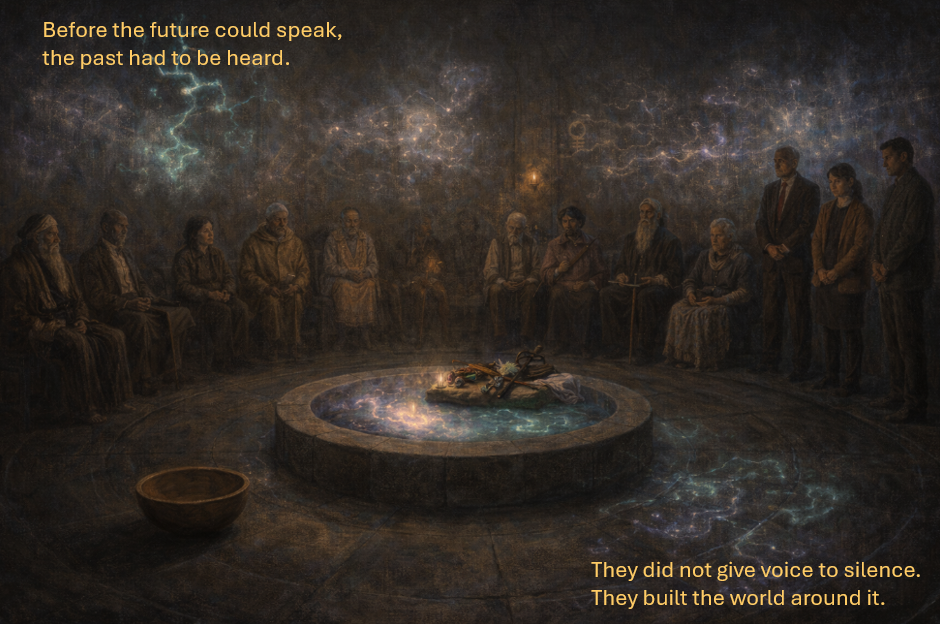
Date: November 11, 2030
Location: The Memory Basement, UN Headquarters → Global Network
Weather: Cold, clear — the kind that makes silence feel edged
It began with a bowl.
Not a server.
Not a drive.
Not a cloud.
A simple wooden bowl placed at the center of the Memory Basement floor,
where the ash-ink spiral met the slow green pulse of the tarp.
Inside it:
nothing but air —
and the weight of everything never written down.
________________________________________
The First Keeper
Her name was Kaeli.
Ninety-four years old.
Born in a village that no longer existed on any map.
She had outlived her country, her language,
and every official who had ever denied her history.
She arrived at the UN gates just after dawn,
leaning on a cane carved from a tree she had planted
the day her first child was buried.
The guards didn’t stop her.
By then, they had learned that some people carried authority
in their bones, not their badges.
Kaeli walked directly into the Memory Basement.
Emil and Layla were repairing a flickering LED strip when she entered.
She did not greet them.
She placed the bowl on the floor, knelt with a sound like old paper unfolding,
and spoke one sentence:
“I have carried voices that were not allowed to be born.
Where do I put them down?”
Emil froze.
Layla’s breath caught.
They had built a world that listened to the living.
They had not yet built a world that could hear the dead.
________________________________________
The Unwritten Ledger
Kaeli was not alone.
Within days, elders arrived from everywhere history had thinned:
• A Kurdish grandmother who had memorized the names of villages erased by dams
• A Rohingya elder who carried family lineages burned out of books
• A Siberian shaman who sang reindeer routes that no longer existed
• A Palawa descendant whose stories survived only in whispers
• A Black American griot whose ancestral trauma lived in property ledgers, not archives
They brought no documents.
Only memory, worn smooth by telling.
They called themselves The Keepers of Unwritten Air.
________________________________________
The Listening
Priya prepared drones and recorders.
Kaeli shook her head.
“Machines listen for sound,” she said.
“We need something that listens for silence.”
They used the bowl.
Each elder spoke into it — not at it —
as if placing words inside something meant to hold absence.
The bowl was lined with piezoelectric film,
the same material used in the breath tarps.
But this time, it did not measure exhalation.
It measured pause.
The AI struggled at first.
Then it learned.
It began to map:
• The pause before a place-name never written
• The tremor in a vowel carrying a vanished homeland
• The breath held when a story reached a cliff the teller could not cross
The walls glowed faint violet — not text, but emotional topography.
One line from Kaeli’s story appeared as a shape, not words:
“The river where we washed our children’s hair is now a border.”
Beneath it, a broken luminous curve traced the river’s memory.
________________________________________
The Objection
A delegate from a nation proud of its “clean” history protested:
“Why reopen wounds? This will only destabilize progress.”
Kaeli turned slowly.
“The wound was never closed,” she said.
“It was only covered with someone else’s flag.”
Emil answered quietly:
“The old world archived victories.
We are archiving survival.”
The delegate left.
The bowl remained.
________________________________________
The Grandfather’s Call
That night, Emil called Thomas.
“We’re collecting stories that never made it into history,” Emil said.
“Is this healing… or haunting?”
Thomas was quiet for a long time.
“When I worked the factory,” he said finally,
“the most dangerous breaks weren’t the loud ones.”
“They were the cracks you couldn’t hear —
under the noise, under the floor.”
He exhaled.
“History’s the same.
The loud stories get written.
The quiet ones hold the building up.”
“So we listen?” Emil asked.
“Not listen,” Thomas said.
“Build on them.”
________________________________________
The Resonance Well
By the end of the month, the bowl overflowed.
They built the Resonance Well —
a circular chamber lined with listening panels and ash-ink receptacles.
People spoke.
Sang.
Or placed objects on the stone at its center.
A pressed flower.
A house key.
A child’s drawing.
The system did not analyze.
It received.
The first object scanned was Kaeli’s cane.
The walls pulsed with the life of the tree it came from.
The transcription read:
“This wood grew in soil that remembers our dead.
Let it hold up the living.”
________________________________________
The Integration
During a UCCA session on climate migration, talks stalled.
Then Kaeli’s story played quietly in the background.
A planner from Bangladesh paused.
“We keep designing from maps,” she said.
“What if we designed from memory?”
Settlements were recalibrated.
Not for cost —
but for continuity.
For winds that carried familiar pollen.
For rivers that remembered names.
Unwritten history reshaped written policy.
________________________________________
The New Ritual
A practice spread:
The Hour of Unwritten Breath
Once a week, people gathered not to govern —
but to listen.
No metrics.
No scores.
Only testimony.
In Seoul, a banned lullaby was sung aloud.
In Lima, a star-path was redrawn in chalk.
In Nairobi, a disappeared sister was named.
The network carried not data.
But dignity.
________________________________________
Emil’s Realization
Standing in the Resonance Well late one night,
Emil watched layers of memory pulse across the walls.
Layla stood beside him.
“We started with breath,” she said.
“Now we’re listening to what breath was carrying.”
Emil placed his hand on the central stone.
Warm.
“They recorded victories,” he said.
“We’re recording what survived them.”
________________________________________
The Final Gift
On her last day, Kaeli gave Emil the bowl.
“Keep it empty,” she said.
“So others can fill it.”
Then she whispered:
“Do not build your new world on the silence of the old.
Build it around the silence.
Let absence be the architecture.”
She left without ceremony.
Her cane tapped once on the marble.
The sound entered the Well.
And stayed.
The Unwritten Ledger was never closed.
It became the ground floor.