
 0
0
 422 views
Date: September 2030
Subtitle: When the Old World Learned to Imitate the New
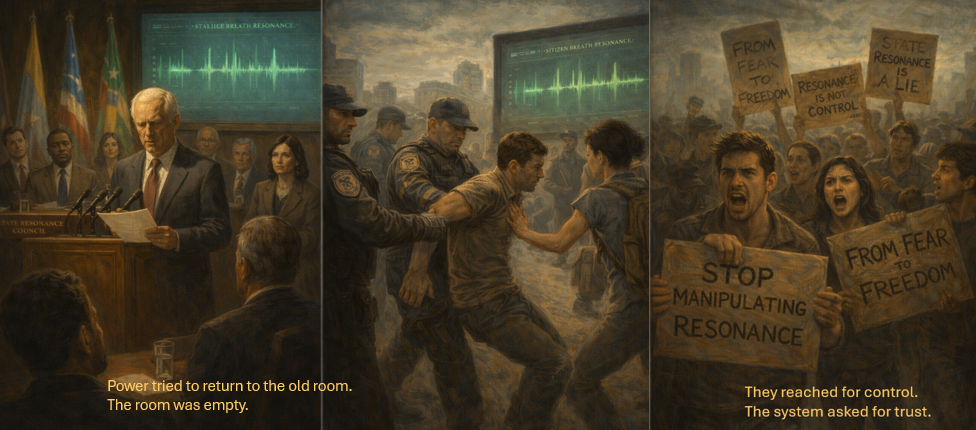
The counter-revolution did not arrive in tanks.
It arrived in language.
________________________________________
The Imitation Phase
The first press release came from a familiar capital.
“We support resonance-based governance.”
The second followed within hours.
“Our nation has always prioritized collective well-being.”
Within days, dozens of governments unveiled official Breath Councils,
State-Certified Resonance Panels,
and National Harmony Initiatives.
They used the words carefully.
They used the colors correctly.
They even copied the dashboards.
What they did not do
was let go of control.
________________________________________
Breath With Conditions
In one country, citizens were invited to “breathe together”
— but only in approved venues.
In another, resonance scores were published
— but only after being “contextualized” by ministries.
In a third, breath sensors were installed in public buildings
— and quietly cross-linked with identity databases.
Participation rose.
Trust did not.
A warning ripple flashed amber across the network:
Pattern detected: Symbolic adoption without structural transfer
The system had seen this before.
Just not at planetary scale.
________________________________________
The Manufactured Calm
A coalition of states introduced what they called
Stability-Weighted Resonance.
It sounded technical.
It sounded responsible.
It was neither.
The algorithm penalized emotional variance,
downgraded dissent,
and rewarded predictability.
Cities went green overnight.
Too green.
In one capital, protests vanished in a week.
Not because grievances were solved—
but because breath data was filtered.
A street artist spray-painted a question on a shuttered café:
“If calm is mandatory, who decides what hurts?”
The mural lasted twelve minutes.
The question spread anyway.
________________________________________
The First Crackdown
The first arrests were administrative.
Data technicians.
Community facilitators.
Teachers who refused to alter dashboards.
No charges announced.
No trials scheduled.
The justification was always the same:
“To protect national stability.”
A quiet memo leaked from an interior ministry:
“Resonance governance must be sovereign.”
That sentence did more damage than any speech.
________________________________________
UCCA’s Dilemma
The United Coalition of City Assemblies convened in emergency session.
No one spoke for a long time.
Finally, a planner from Accra said:
“If we confront them, they’ll call us unelected.”
“If we ignore them, they’ll hollow the system out.”
Amara Okonkwo listened, hands folded.
She spoke once:
“This was always coming.
Power never retreats without trying to wear a new face.”
________________________________________
The Counter-Move
UCCA did not issue sanctions.
Did not name enemies.
Did not declare illegitimacy.
Instead, they released a single protocol:
The Open Breath Rule
Resonance data is valid only when:
• participation is voluntary
• algorithms are inspectable
• dissent is measurable, not suppressible
• no identity linkage is required
• any community can audit the system in real time
No enforcement mechanism.
No punishment.
Just transparency.
Cities adopted it immediately.
States hesitated.
The difference became visible within days.
________________________________________
The Failure of the Takeover
People noticed.
Not through announcements—
through feeling.
Official platforms felt tight.
Performative.
Watched.
Community systems felt alive.
Messy.
Honest.
Breath doesn’t obey authority.
It follows trust.
Participation drained from state-run systems
like water finding a lower path.
The counter-revolution didn’t collapse.
It starved.
________________________________________
The Lesson the Old World Learned Too Late
A senior advisor to a head of state summarized it privately:
“You can regulate behavior.
You can’t regulate consent.”
For the first time, power realized:
The new system could not be seized. Only joined.
________________________________________
Closing Scene
Emil watched the dashboards late into the night.
Red flared briefly in places that tried to clamp down.
Green stabilized where transparency held.
Layla stood beside him.
“They tried to take it back,” she said.
Emil nodded.
“They always will.”
A pause.
“But now,” Layla added,
“we can see them try.”
The system breathed.
Not faster.
Wiser.