
 0
0
 341 views
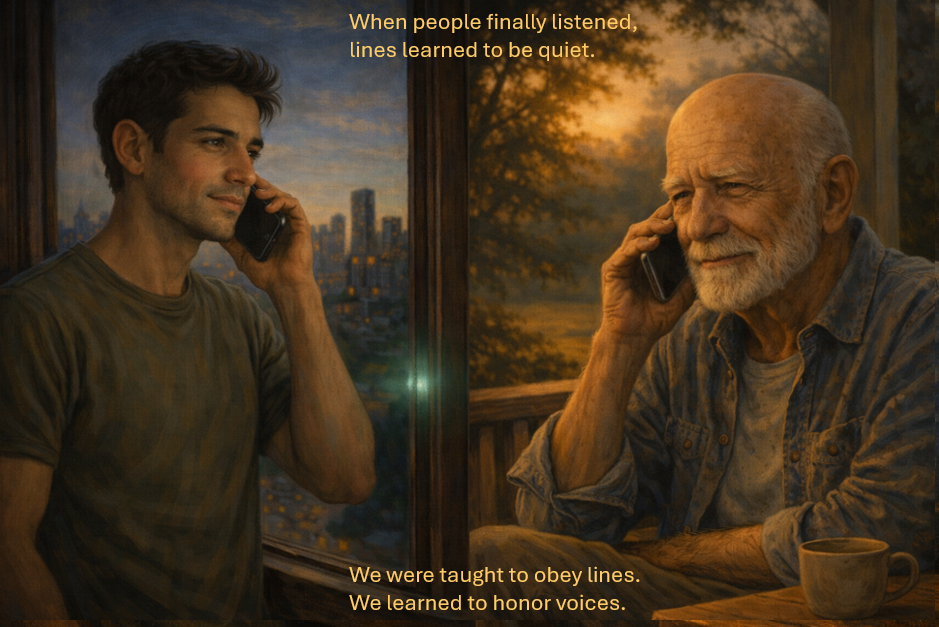
Date:July 2030
Location: Emil’s Brooklyn apartment • Grandfather Thomas’s porch
The call came just as the sun finished sliding behind the city.
Emil had been watching the border feed again —
the one where a guard knelt to tie a child’s shoe
instead of checking a passport.
He answered on the first ring.
“Hey, Grandpa.”
Thomas didn’t speak right away.
When he did, his voice carried something unfamiliar.
Not awe.
Not anger.
Recognition.
________________________________________
“I think I finally understand what you kids did,”
Grandfather said.
Emil leaned against the window.
“You say that every time.”
Thomas chuckled softly.
“No. This time’s different.”
A pause — wind moving through trees on the other end.
________________________________________
Grandfather’s Insight
“You didn’t make the world borderless,” he said.
“You made it relational.”
Emil frowned slightly.
“Relational?”
“Yeah,” Thomas continued.
“For most of my life, governance was about lines, categories, enforcement.
Who’s in. Who’s out.
Who belongs on which side of an argument.”
He took a breath.
“But what I’m seeing now…
people aren’t asking where someone is from first.”
Emil watched a family cross the field on his screen.
“They’re asking,” Grandfather said,
‘Who are you to me?’”
________________________________________
A Systemic Shift, Not a Revolution
“You know what borders used to do best?” Thomas went on.
“They simplified responsibility.
If someone suffered on the other side,
we could say it wasn’t our problem.”
Emil felt that land hard.
“But now?”
Thomas’s voice softened.
“When people breathe together — even once —
it’s hard to pretend you don’t recognize the other lung.”
Silence.
Not empty.
Settled.
________________________________________
Emil’s Question
“So…
is that good governance?” Emil asked.
“Or are we just being naïve?”
Grandfather smiled — Emil could hear it.
“Son, naïve systems collapse the first time they’re tested.
This one just survived its first mistake.”
He paused.
“That’s how relationships work.
They don’t eliminate friction.
They carry it.”
________________________________________
The Line That Matters
Thomas added, quieter now:
“For centuries we built systems that managed strangers.
What you’re building manages neighbors.”
Outside, the city breathed — not synchronized, not perfect.
Human.
________________________________________
“Don’t rush to name it yet,” Thomas said.
“Let people live into it first.”
The call ended gently.
Emil remained by the window.
Below him, the city moved —
taxis passing, lights changing,
strangers crossing paths without noticing one another.
On the muted screen beside him,
the feed replayed the moment —
the child’s shoe, the kneeling official,
the pause where no one was in charge,
and no one was afraid.
For the first time,
governance didn’t feel like something designed above people.
It felt like something people were quietly practicing
between themselves.