
 0
0
 342 views
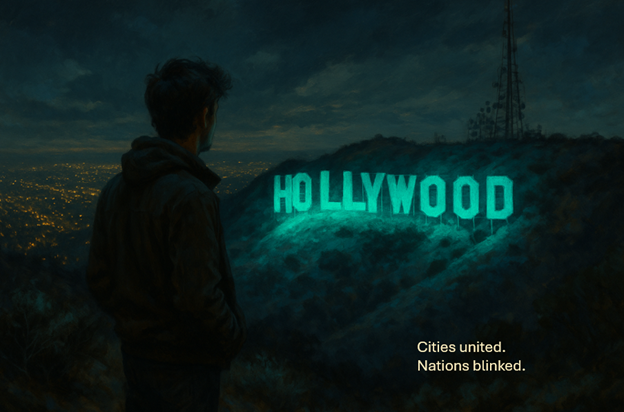
Case Study: United States of America — September 2029
The land that once sold the dream found itself waking up.
The First Cracks Were Digital
In the months after The Planetary Accord, the world breathed green.
But America breathed two colors:
Blue and Red.
Two realities.
Two truths.
One flag fraying from the center.
The Breath Network Map showed cities pulsing teal while entire rural belts stayed red.
Not disagreement.
Disconnection.
Gerrymandered Ghosts
Counties where five thousand voters lived claimed the same political weight
as cities with five million lungs.
The system’s distortion was visible now:
the lines on the map glowed red where democracy had been carved
into a weapon.
Priya’s drone annotated the broadcast:
“Power without people detected.”
The nation didn’t understand whether that was a glitch…
or a diagnosis.
The Capital of Two Countries
Washington, D.C.
The Senate sat paralyzed —
half insisting the breath vote was foreign interference because it did not favor them.
The other half insisting ignoring it was treason because it favored everyone.
A senator shouted:
“Real America didn’t vote!”
A young Capitol staffer replied:
“Real America just did.”
The hearing room fell silent except for a teal heartbeat glowing across their screens.
The First City to Leave
90% Resonance: Los Angeles
LA declared it would no longer wait for a country
that waited only to fight itself.
Mayor’s statement:
“We govern by breath now.
Anyone who wants to join us
only needs lungs.”
Within 24 hours San Francisco, Seattle, and Denver
followed.
A coastline became a country.
City Nations were real.
The Collapse of Broadcast Truth
CNN and Fox News aired completely different graphics
of the same vote.
One said the world was united.
One said the world was confused.
Viewers believed whichever screen scared them more.
Then, something unprecedented:
Both networks lost credibility simultaneously.
Millions of Americans closed their TVs and opened their windows to listen to each other breathe.
It was the first truth they had shared in decades.
The Military’s Quiet Choice
Pentagon Operations Room
The Joint Chiefs considered deploying forces to “restore national integrity.”
But then a Marine General placed his phone
on the table showing his daughter in Atlanta breathing in a teal-lit crowd.
He set his badge next to it.
“My oath is to the people.”
No troops mobilized.
The Line That Moved
At the Texas-New Mexico border a ranch fence that once symbolized sovereignty
glowed teal and flickered out like an outdated screen saver.
People walked through it as if it had never been real.
No one died.
No one protested.
They just crossed —
and kept walking.
Fear didn’t stop them.
Breathing did.
The Final Presidential Broadcast
The President faced the cameras,
voice shaking:
“This nation cannot survive as two Americas.
We must become one world.”
The map behind her no longer showed states.
It showed clusters of human resonance:
Atlanta. Houston. Detroit.
Chicago. Philadelphia.
Phoenix. Minneapolis.
New York. Miami.
Cities forming a network stronger than borders.
Red States, Blue States → Breath States
The United States didn’t fall.
The idea of “United”
simply shifted
to where unity lived.
The new map would later be described as:
“Where people help each other thrive, they are one country.”
America didn’t break apart.
It finally stopped pretending
that fear was what held it together.
________________________________________________________________________________
Emil Watching America Become Breath
Location: Brooklyn rooftop, same moment as LA declares City-Nationhood
Emil stared at the television they’d dragged to the roof—
a tiny box broadcasting a continental transformation.
The Hollywood sign pulsed teal like a heartbeat carved into a mountain.
Priya murmured:
“LA just left the country.”
But Emil didn’t cheer.
He didn’t smile.
His chest felt heavy— as if the air was warning him
that power doesn’t change sides without consequence.
He whispered to no one:
“This was always going to happen…
just not like this.”
He thought about his mother—
how insurance paperwork outweighed breath
on the night she died.
He thought about the people now celebrating:
millions free of that same fear.
Then he thought about the millions not celebrating—
millions who would see this as theft, as abandonment, as war by another name.
Layla’s voice broke through:
“You okay?”
He didn’t answer immediately.
On the screen, the Los Angeles skyline glowed
like a new capital of humanity.
But beneath that glow lurked a question big enough to swallow the world:
What happens to a nation when part of it moves forward
and the rest stays behind?
Emil finally looked at Layla.
“If a border can disappear,”
he said quietly,
“so can the people who depended on it.”
Priya’s drone camera caught a family hugging under neon in Koreatown—
their first night without citizenship.
Sami tugged Emil’s sleeve:
“Are we still one country?”
The city lights reflected in Emil’s eyes—
a mosaic of fear, awe, and decision.
He exhaled slowly.
“Maybe the country is still deciding.”
The drone projected a new notification across the rooftop tension:
City Nation — APPROVED
Resonance threshold met
(88% → 91% → 94%)
As the numbers climbed, Emil understood:
The future wasn’t waiting for a unanimous vote.
It was already walking out the door.
And it expected him to keep up.
_____________________________________
The End of Two Americas
Published in The Atlantic Global — September 2029
For decades, America had two maps:
- A political map — red vs. blue
- A psychological map — fear vs. fear
Both were lies told long enough to feel true.
One half believed the other stole the country.
The other half believed the first incinerated its soul.
They fought over elections like lifeboats on a sinking ship.
But the Breath Network didn’t ask for sides.
It asked for lungs.
When millions inhaled together —
the colors disappeared.
The cities didn’t secede from the nation.
They seceded from the argument.
They refused the idea that a line drawn by a cartographer should decide who gets to live well.
“Where people care for each other, they are one country — regardless of what the map says.”
The two Americas didn’t reconcile.
They simply stopped being useful.
What emerged was not a union of states but a union of needs:
Heat in winter Food without debt Medicine without paperwork
News without panic
Work without exploitation
Life without fear
Borders were no longer drawn between counties
but between:
- Well-being vs. greed
- Humanity vs. profit
For the first time since 1776, America wasn’t defined by its disagreements…
but by its breath.
And the United States finally lived up to its name.