
 0
0
 258 views
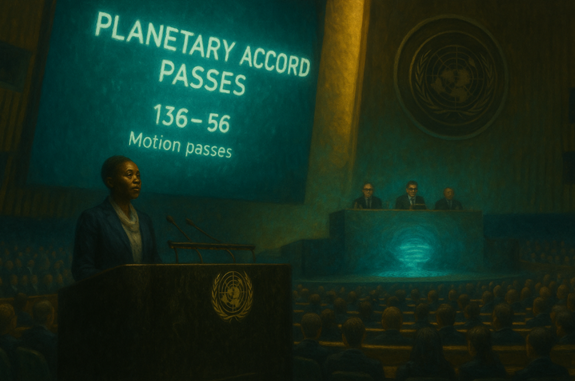
Date: August 14, 2029 — 09:00 UTC
Location: UN General Assembly Hall, New York
Atmosphere: The last moment before everything changes
They called it
Resolution A/ES-16/1: The Planetary Accord
but that name would not survive history books.
People later called it something simpler:
“The Vote Where the World Chose Itself.”
The Hall Before the Storm
Every seat in the General Assembly was filled.
Delegates sat with their hands folded,
as if touching anything might trigger collapse.
The flags along the balcony
looked suddenly outdated—
decorations for a world
that no longer existed.
Cameras hovered in silence.
Even the translators leaned forward,
waiting for meaning.
At the center podium stood Amara Okonkwo.
No binder.
No teleprompter.
Just a small gray stone
at the edge of her notes—
Sami’s offering from The Circle.
A reminder
that the new world had already begun.
The Secretary-General’s Last Speech in the Old System
“Distinguished delegates,” she began.
“I ask you to consider
that we have been breathing in place
for seventy-eight years.”
She let the sentence rest.
“Today,
for the first time,
the world is breathing forward.”
A slow inhale from the gallery.
An exhale from the floor.
She continued:
“The Planetary Accord is not a replacement.
It is an expansion.
Nations will remain.
But they will no longer be
the only lungs of humanity.”
On the screens,
the day’s key line appeared in 197 languages:
“Representation shall include any community
capable of sustained resonance.”
A diplomat from a small island
clutched his headset
as though this sentence
had given his people immortality.
Three Votes That Defined the World
The proposal required three separate approvals:
Vote 1 — Recognition of Cities
Pass. 167–25.
Applause from the balcony.
Silence from the Security Council seats.
Vote 2 — Creation of the UCCA
(United Cities & Communities Assembly)
Pass. 154–38.
A cluster of capitals dimmed red
on global dashboards.
Fear.
Or acceptance.
Hard to tell.
Vote 3 — Equal Legal Authority
This was the quake.
It would mean:
- Cities could propose global law.
- Nations could no longer override them unilaterally.
- The veto would never rise again.
The screen flashed:
“Commence Vote.”
The hall held its breath.
Literally.
The Moment of Resonance
While nations voted,
cities watched from plazas and squares:
- Seoul — 43,000 gathered in Gwanghwamun
- Mexico City — 120,000 in Zócalo
- Lagos — the biggest assembly yet, 280,000 at Freedom Park
- Oslo — Frogner Park a sea of teal scarves
- Manila — traffic stopped itself
- São Paulo — Avenida Paulista glowing unbroken emerald
- Chicago — the Riverwalk pulse reflecting in the water
Sensors everywhere registered
a rising synchrony curve.
It was as if the act of voting
was happening at street level,
not in the hall.
When the screen showed the tally:
136–56.
Motion passes.
The hall did not erupt.
It inhaled.
The Sound That Wasn’t Sound
Across the planet, millions of people exhaled together.
Not cheering.
Not chanting.
Breathing.
A single low-frequency pulse
rippled across earth’s cities—
captured in real time
by orbital sensors.
A science journalist wrote:
“The planet achieved coherence.”
The Reactions Inside the Chamber
Some delegates wept with relief
or terror
or both.
The representative from India
removed his lapel pin
and placed it gently on the table.
The U.S. ambassador looked stunned,
as if democracy had just evolved
without asking permission.
The French delegate whispered:
“Liberté… enfin mondiale.”
And the Chinese envoy—
who had voted abstain—
closed his eyes,
acknowledging where history had turned.
Amara’s Final Line
She placed a hand on the gray stone
and spoke clearly:
“Let this assembly
never again silence
the voice of the living world.”
The Birth of a Second Chamber
Within hours:
- The first 40 cities volunteered delegates
- Nairobi uploaded its resonance charter
- Seoul lit its city hall teal
- Dubai offered AI infrastructure
- Oslo pledged Sámi stewardship
- São Paulo announced multilingual breath protocol
- Chicago proposed the first trans-border district
- Cape Town opened a “Breath Embassy”
in the old District Six
The world did not wait for paperwork.
It moved.
Amara looked up at the balcony where youth delegates watched.
She nodded.
And in that gesture
the old system
finally bowed to the new.