
 0
0
 398 views
Date: May–September 2028
Global Status: Confusion, panic, imitation, denial, collapse
Primary Locations: Washington, Beijing, New Delhi, Moscow, London, Abuja, Brasília, Dubai, Riyadh, South Africa, Oslo
For six weeks, the Breathing Cities had grown like constellations across the planet —
a glittering network of teal pulses from rooftops and bridges and marketplaces.
And for six weeks, nation-states said nothing.
Silence is not neutrality.
Silence is the sound a structure makes
when it’s deciding whether to adapt or attack.
On May 29, the silence cracked.
- Washington — The Executive Concern
A classified memo leaked from the White House Situation Room:
“Breath governance is creating parallel legitimacy structures in 32 cities.
Assess whether this constitutes a non-state challenge to federal authority.”
The administration held emergency meetings.
Generals did not understand it.
Senators underestimated it.
Strategists feared it.
A junior advisor, barely 25, said the quiet part:
“Sir… if a million people breathe together,
they will not wait for Congress.”
The President looked out the window.
For the first time in 30 years,
Washington felt old.
- Beijing — The Red Line of Resonance
China responded with precision.
On June 2, state media declared breath assemblies
“unregulated gatherings that may cause public disharmony.”
But something unexpected happened.
Students at Tsinghua and Beida
held whisper assemblies in dorm rooms —
voting silently with breath signatures transmitted through hidden apps.
The government tried to block the resonance network.
It failed.
Breath packets routed themselves through
gaming servers,
drone feeds,
and even abandoned COVID contact-tracing APIs.
The state could censor speech.
It could not censor respiration.
- New Delhi — The Legal Countermove
India’s response was legalistic and contradictory.
A midnight ordinance declared that:
“Breath-based civic processes cannot replace parliamentary procedure.”
But by morning,
five Indian cities were already using breath-votes
to manage water shortages,
traffic flow,
hospital triage,
and migrant relocation.
The ordinance became meaningless
before the ink dried.
A Delhi High Court judge suspended it entirely after reading the case files,
saying:
“If breath is the reason life begins,
how can it be the reason democracy ends?”
- Moscow — The Fear Reflex
Russia acted fastest.
On June 4, the government declared resonance apps
a threat to national security.
But that night, in St. Petersburg,
thousands gathered silently by the Neva River
with teal candles and no phones.
They voted with nothing but rising frost.
Police tear gas didn’t work —
because people didn’t scatter.
They exhaled together
and the fog thickened into a glowing mist.
The footage went viral:
“You cannot disperse breath.”
- London — The Parliamentary Panic
Britain tried humor.
Late-night hosts joked:
“Breathing? In this economy?”
“Finally, a vote no one can blame on Brussels!”
But the joke ended on June 7
when 300,000 Londoners gathered in Hyde Park
to breath-vote on homelessness
after a brutal heatwave.
The vote passed by 92%.
The next morning,
Parliament launched a formal inquiry
into “extra-parliamentary civic decision-making.”
The public laughed.
Parliament did not.
- Abuja — The Quiet Endorsement
Nigeria surprised everyone.
Instead of resisting,
the government invited representatives
from Lagos Breath Councils
to speak at the National Assembly.
A senator stood up and said:
“Maybe the cities are not rebelling.
Maybe they are rehearsing the future.”
Lagos received federal support two days later.
The first country to partner
with the Breathing Cities
was not one of the “powerful five,”
but one that had always been ignored.
The world took notice.
- Brasília — The Imitation
Brazil tried something bold.
They launched the National Inhale,
a state-run version of the breath system.
It was controlled, limited, surveilled.
But on day one,
the servers crashed
because 14 million Brazilians joined at once.
The people used the system
faster than the state could manipulate it.
The next day,
Brazil admitted reality:
“The people are ahead of us.
We will follow.”
- Dubai — The City That Breathes in Algorithms
Dubai moved faster.
The city announced the creation of the Dubai Breath Lab,
a glittering hybrid of public plaza and digital architecture
built next to the Museum of the Future.
Huge transparent columns filled the plaza,
each one glowing softly with real-time breath signatures from residents
measured through public sensors, transit hubs, and workplaces.
A journalist called it:
“The world’s first real-time emotional weather map.”
And Dubai embraced it.
- Traffic signals adjusted based on neighborhood stress levels
- Cooling systems in outdoor walkways activated when collective breath tightened
- Migrant worker dormitories received airflow priority on high-heat days
- Tourism advisories were updated by resonance patterns instead of PR campaigns
Dubai didn’t fear breath governance.
It branded it.
A billboard near Sheikh Zayed Road declared:
DUBAI —
THE FIRST CITY WHERE THE AIR LISTENS BACK.
Exporting the Breath
While other nations panicked or suppressed,
Dubai did something no one expected:
It began exporting the technology. AI reduces the technology development life cycle.
Not quietly.
Not cautiously.
Openly — like a city announcing a new airline route.
On September 19, the Dubai Executive Council unveiled:
“The Global Breath Infrastructure Initiative (GBII)”
—a partnership program offering:
- resonance sensors
- adaptive airflow grids
- stress-mapping towers
- civic breath dashboards
- population-level emotional analytics
- portable breath-vote tarps
- multilingual resonance apps
- and a full training suite for city officials
to any city willing to adopt the Dubai Breath Lab model.
Within twenty-four hours,
six cities applied.
Within a week,
twenty-two.
Dubai’s Strategic Play
Behind closed doors,
the Executive Council reportedly used a phrase
that would later appear in leaked documents:
“If nations resist the future,
we will help cities build it.”
Dubai wasn’t trying to replace governments.
It was doing something more subtle:
making cities the new customers
of governance technology.
And in doing so,
it shifted the balance of global power
without firing a single shot
or issuing a single law.
- Riyadh — The Controlled Breath
Saudi Arabia didn’t ban breath assemblies.
It studied them.
Within days, analysts in the Royal Court were running simulations
on how resonance-based governance might affect:
- water distribution networks
- labor migration flows
- pilgrimage logistics
For a kingdom built on resource management,
breath was not a political threat.
It was a metric.
A senior advisor was overheard telling the Crown Prince:
“If breath can predict social cohesion better than polling,
then we should use it before the world does.”
The government quietly launched NAFAS,
a controlled “breath sentiment index,”
disguised as a wellness app.
Within a week,
millions were using it to track sleep and stress levels—
and without realizing it,
their breath patterns were shaping urban planning decisions in Riyadh and Jeddah.
In a month, water distribution networks were optimized.
Neighborhoods exhale during scarcity, inhale during surplus.
Resonance signals show stress spikes in specific districts.
Smart water grids reroute supply based on collective breath sentiment rather than political priority.
Impact
Water is allocated to the most distressed areas first, not the wealthiest.
Leak detection becomes citizen-driven: areas with repeated “stress-breath” spikes get sent repair crews.
Seasonal policies are shaped by real-time breath sentiment.
The outcome was that water becomes a living system, responding to citizens rather than planners.
Saudi Arabia had not rejected the Breathing Cities.
It had localized them.
- South Africa — The Resonance of Memory
South Africa did something far more dangerous:
It remembered.
On June 10, a breath assembly erupted spontaneously in Hillbrow, Johannesburg.
No drones.
No LED tarp.
No activists.
Just residents —
Zimbabwean migrants, South African vendors, Somali shopkeepers, Congolese workers,
standing in a cracked parking lot behind an old apartment block.
A grandmother in a red doek raised her arms and said:
“Apartheid told us our breath did not count.
We will not let our democracy do the same.”
People inhaled.
Phones lit up.
Children watched the sky as if waiting for something sacred to descend.
The resonance hit 93%.
It wasn’t a vote.
It was an echo of history.
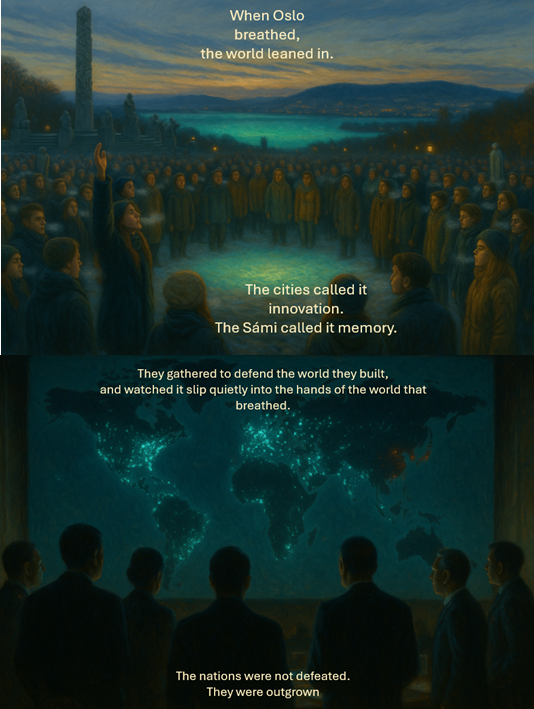
- Oslo — The Quiet Rebellion of Trust
Norway’s response was the quietest
and therefore the most dangerous.
On June 12, Oslo woke to a single headline:
“We breathed.”
No explanation.
No political party name beneath it.
Just two words on the front page of Aftenposten.
That morning, the Prime Minister called an emergency meeting with the Justice Ministry, the Climate Ministry, and the mayors of Oslo, Tromsø, Bergen, and Stavanger.
But Oslo had already moved.
At sunset, without permits or speeches,
more than 9,000 people gathered in Frogner Park.
No organizers.
No influencers.
No official hashtags.
Just Norwegians of every age
standing between sculptures of human forms
— the perfect place for a city learning to breathe as one.
A teacher raised her hand.
“Should Oslo become a Breathing City?”
No applause.
Only breath.
Phones pulsed green across the park
like fireflies made of empathy.
The vote passed 98%.
Unlike other nations, Oslo did not respond with fear.
Nor with suppression.
Nor with legal threats.
They responded with a question:
“Can this make us better?”
Because Norway had something most nations did not:
a national memory of cooperation
that had survived a century of storms.
The government issued a cautious statement:
“Breath assemblies do not replace democratic institutions,
but we acknowledge they may strengthen democratic legitimacy
in matters requiring urgency or empathy.”
It was the gentlest endorsement in modern political history.
A group of parliamentarians met after hours,
screens glowing with live resonance maps
from Oslo, Trondheim, and Bergen.
A conservative MP whispered:
“If we trust the people enough to give them free education,
why not trust them enough to breathe together?”
A Labour MP responded:
“Because breath cannot be lobbied.”
A deep silence followed.
Everyone understood the implication:
Breath governance was incorruptible in ways politics had never been
The breakthrough came from the north.
The Sámi Council, representing Indigenous communities across Norway, Sweden, and Finland, released a statement:
“Breath governance is not modern.
It is ancient.
You have rediscovered what our ancestors knew—
that consensus is not spoken.
It is felt.”
Oslo paused.
Something old had aligned with something new.
The world didn’t expect Paris to resist,
or Washington to panic.
But Oslo’s response was different:
They neither embraced nor rejected the Breathing Cities.
They listened.
And that terrified other nations,
because Norway was the first government to realize:
Breath governance was not an uprising.
It was an upgrade.
- The UN — The Diplomatic Breakdown
Inside the Security Council chamber,
delegates sat with tablets open
showing live resonance maps from their capitals.
The ambassador from France muttered:
“Cities no longer wait for nations.”
The ambassador from China replied:
“Nations no longer lead cities.”
The U.S. ambassador whispered:
“Then who governs?”
No one answered.
The scar on the table
seemed to pulse under the fluorescent lights.
- Other Developments
The open-source Trust Pulse app reached 100 million downloads.
Neighborhoods used it to decide whether to repair a playground or plant trees. A village in Kerala, India used it to stop a dam. A co-op in Detroit, USA used it to keep the factory open instead of selling it.
In 47 countries, teenagers began refusing to stand for national anthems unless the lyrics were amended to include the sentence “We breathe the same air.” Most schools quietly stopped playing anthems rather than negotiate with children.
Porto Alegre, Brazil passed the first municipal “Breath Budget.” Four percent of the city treasury was allocated by open resonance vote on the central square. Trust Pulse: 97.3 %. The old city council attended, sat on plastic chairs, and did not speak once.
Oil producing nations get together and created a new oil demand forecasting model. Breath assemblies across global cities generate real-time data on:
- public transit frustration
- fuel affordability stress
- climate anxiety
- desire for renewable shifts
This data plugs into demand models.
- Oil-producing nations pivot faster:
When global breath sentiment shifts toward “climate relief,”
demand drop is predicted weeks earlier than market analysts. - Price wars become less violent because moves are based on collective human condition, not speculation.
- Domestic policies (subsidies, production caps) respond to local breathing patterns, not elite forecasts.
Outcome
Oil becomes tied to human emotional climate, not just financial markets.
- The Embassies Panic
In the foreign ministries of the world,
a new fear emerged:
If cities speak for themselves,
whom do we send ambassadors to?
Capital cities realized
their monopoly on international representation
was dissolving.
A city with breath governance
could negotiate faster
than a nation with diplomats.
Power was redistributing
like water on a tilted surface.
- Emil Watches It Happen
At the Embassy of Breath,
Emil watched red dots (government denouncements)
spread across the map
like warnings.
Then he watched
teal dots (breath assemblies)
outnumber them
like stars outnumber streetlights.
Layla walked in behind him.
“They’re scared,” she whispered.
Emil didn’t turn from the map.
“They should be.”
By Sep 30, 2028,
every major national government had issued
a statement, decree, ban, or countermeasure.
None of them worked.
Because for the first time in history:
Legitimacy flowed upward
from people to cities—
not downward from nations to citizens.
The old world was not collapsing.
It was evaporating.
And everyone could feel
something immense approaching.
Something the nations feared.
Something the cities invited.
Something the people were building breath by breath.
The Collapse of Silence.
They never took power. They just stopped asking for permission to be human. And the world followed.